How to Approach Art Galleries
What this helps you do
Send a relevant, focused gallery introduction.
Approaching galleries well is a professional skill, not a personality trait. The artists who get responses aren't necessarily the most connected. They're the ones who send the right thing, to the right person, at the right time.

Before anything else: research
The single biggest mistake artists make is volume-submitting to galleries they haven't researched. A gallery knows within ten seconds whether you've looked at their program. The emails that start "I'm a big fan of your space" and then pitch work that clearly doesn't belong there go straight to trash.
For every gallery you're considering, you should be able to answer:
- Who do they represent, and what does that roster have in common?
- What kind of work have they shown in the last two years?
- What's the scale, medium, and price range of their program?
- Who actually runs the program: director, owner, or curator?
- Do they currently accept submissions, and how?
If your work doesn't fit the program, no amount of strong materials will change that. The right fit is step one.
What to send
The standard professional submission is:
- A short, specific email (under 150 words)
- A one-page artist CV (PDF)
- A short artist statement (PDF, or in the email body)
- A PDF portfolio of 8–12 works with titles, year, medium, dimensions, and prices
- A link to your website or online portfolio
Send PDFs or a single link. Do not attach 20 raw JPEGs. Do not attach zipped folders. Do not use Dropbox or WeTransfer links that expire. A clean PDF and a stable link is professional; anything else makes the gallery do work.
The email itself
The body of a cold submission email is short and concrete. A workable structure:
- One sentence naming you and what you make.
- One or two sentences on why this gallery specifically (reference a recent show, a represented artist, or a program focus, and be genuine).
- One sentence on where you are in your career.
- A link to a portfolio and PDF attachment.
- A closing line, no assumption, no pressure.
What to avoid: paragraphs of biography, adjectives about your own work, phrases like "would love to be considered," or any mention of how long you've been trying to get a gallery.
A viewing room beats attachments
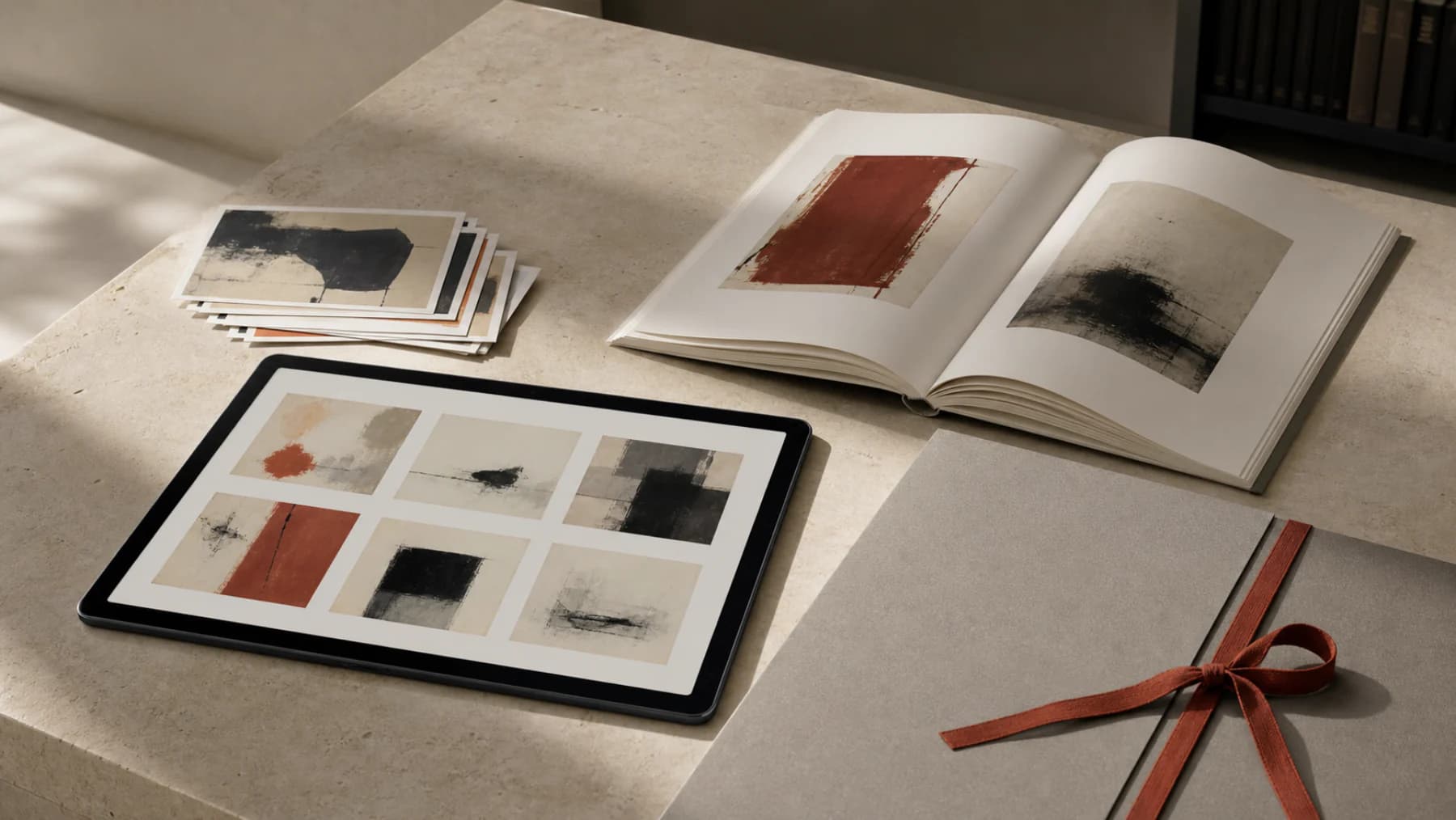
Instead of, or in addition to, a PDF, a private viewing room link can be a much stronger submission. A curated selection of 5–8 works, hosted on a clean page with images at high resolution and full metadata, is closer to how a gallery actually previews work. It's also far easier to share internally with a colleague or co-director.
You can set one up quickly with viewing room software for artists. Password protection is fine; include it in the email.
The PDF portfolio
The portfolio PDF is where many otherwise strong submissions fall apart. What a good one looks like:
- A single title page with your name and contact
- One work per page, with full metadata
- High-quality images, cropped correctly, color-accurate
- Consistent typography and margin
- Most recent or most relevant work first
- No wall text, no long quotes, no artist's family photos
You don't need design software. A decent PDF catalog tool will generate this layout for you from your inventory in minutes.
Etiquette and timing
- Follow the gallery's stated submission policy. If the site says "we do not accept unsolicited submissions," believe them.
- Don't send a submission during an opening week or during a fair. No one will read it.
- A single follow-up after 3–4 weeks is acceptable. A third follow-up is not.
- Never tell a gallery that other galleries are interested unless it's specific, true, and advanced (a concrete offer, not a "conversation").
- Don't ask for a studio visit in a first email. Earn the conversation first.
What actually gets galleries to reply
Galleries reply to specificity, fit, and evidence of a serious practice. Specificity means you've clearly looked at their program. Fit means your work belongs in it. Evidence means a real website, a real CV with real shows, and materials that look like they were put together by someone who respects the gallery's time.
None of this is a trick. It's the minimum professional floor. Most artists never hit it. The ones who do get replies.
Longer-term: how galleries actually discover artists
Cold email works, but it's not the main channel. Galleries find artists through:
- Their own artists recommending peers
- Degree shows, open studios, and residencies
- Group shows at artist-run spaces
- Art-fair section curators
- Curators and writers they trust
- Instagram (still, despite everything)
Building these contexts, from residencies applied for and group shows accepted, strong peer relationships, a public portfolio that stays updated, is slower than cold email but far more productive over the five-year horizon.
Send a gallery a real presentation, not a zip of JPEGs
Artwork Codex lets you generate a polished PDF catalog and a password-protected viewing room in minutes, which is far stronger than an email with attachments.
Paid checkout requires a card. Cancel anytime. The Free plan remains available without a card.
Free plan supports 5 artworks. The Studio plan adds unlimited viewing rooms.