How to Plan an Artwork Series Without Losing the Thread
What this helps you do
Keep a body of work coherent without closing down discovery.
A series gives individual works a larger structure. It can help you think, exhibit, price, write, and sell more clearly. But a series can also become vague if the rules live only in your head. The solution is to define the thread early and document the works as they develop.
At a glance
Key takeaways
- Write the reason for the series in one sentence, then let that sentence guide your choices without becoming a cage.
- Use a few repeatable constraints for size, material, process, or timing to give the body of work momentum.
- Keep the complete series in the archive, then make a more selective public presentation when it is ready.
Define the rule of the series
A series does not need a rigid formula, but it should have a recognisable reason to exist. The rule might be subject, process, material, scale, palette, location, source archive, or question.
Write that rule in a sentence. If you cannot, the series may still be forming. That is fine, but keep notes as it develops so you can understand what changed.
Set useful constraints
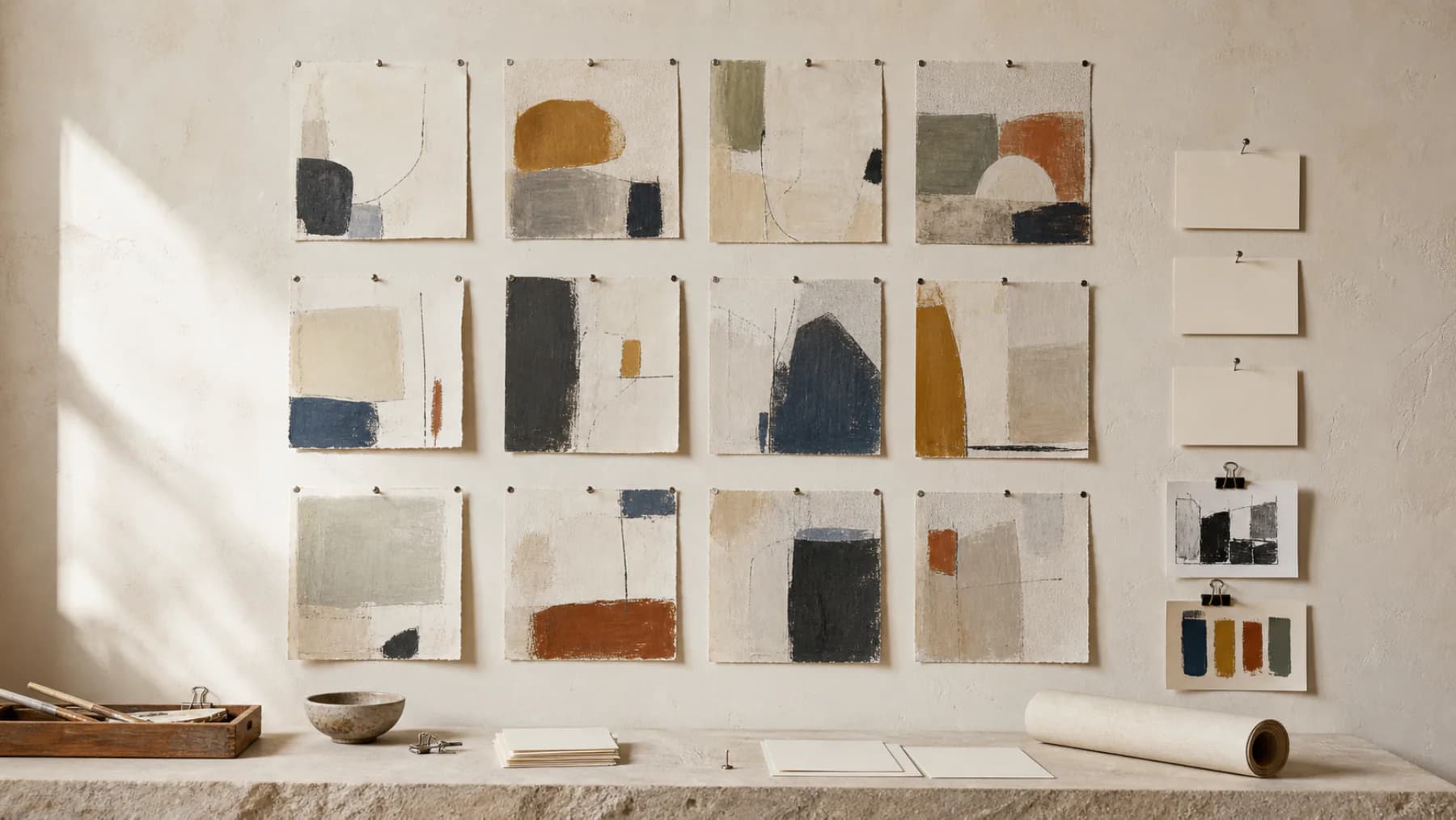
Constraints give a series shape. They might be ten works at the same size, one palette, one motif, one month of daily drawings, or one set of found images.
Good constraints create momentum without choking the work. If every piece requires a new decision about size, material, title, and format, the series can lose energy before it becomes visible.
Title and number consistently
Some series use individual titles. Others use a shared title plus number, such as Night Orchard 01, Night Orchard 02, Night Orchard 03. Either can work.
Whatever you choose, keep it consistent in the artwork records, file names, labels, price lists, and portfolio. Inconsistent titles make the body of work harder to present.
Document process without drowning in it
Process notes are useful for statements, talks, and future reflection. Record material experiments, references, palette choices, location notes, and why certain works entered or left the series.
You do not need to write an essay for every work. A few clear notes attached to each artwork can preserve the thinking behind the series.
Edit before showing
A series is often stronger when not every work is shown. Keep the full archive, but edit the public presentation. Choose the works that carry the idea with the most clarity and variation.
This is where collections are useful. One internal collection can hold the whole series, while a public portfolio or viewing room shows the selected version.
Use the series to make communication easier
Once the series is documented, it becomes easier to write a statement, make a PDF catalog, build a viewing room, price work consistently, and explain the body of work to galleries or collectors.
The series is not only a creative structure. It is also a practical unit for the professional life of the work.
Worked example
A series note you can use
This series follows evening walks along one river over twelve months, using indigo, graphite, and a fixed 30 x 40 cm format. That short note gives you a useful rule for making, naming, selecting, and later explaining the works.
Keep each series organized as it grows
Artwork Codex lets you group works into collections, track details, attach notes and images, and turn a body of work into a portfolio, viewing room, or PDF catalog.
Paid checkout requires a card. Cancel anytime. The Free plan remains available without a card.
Free plan available. Series make more sense when the records stay together.