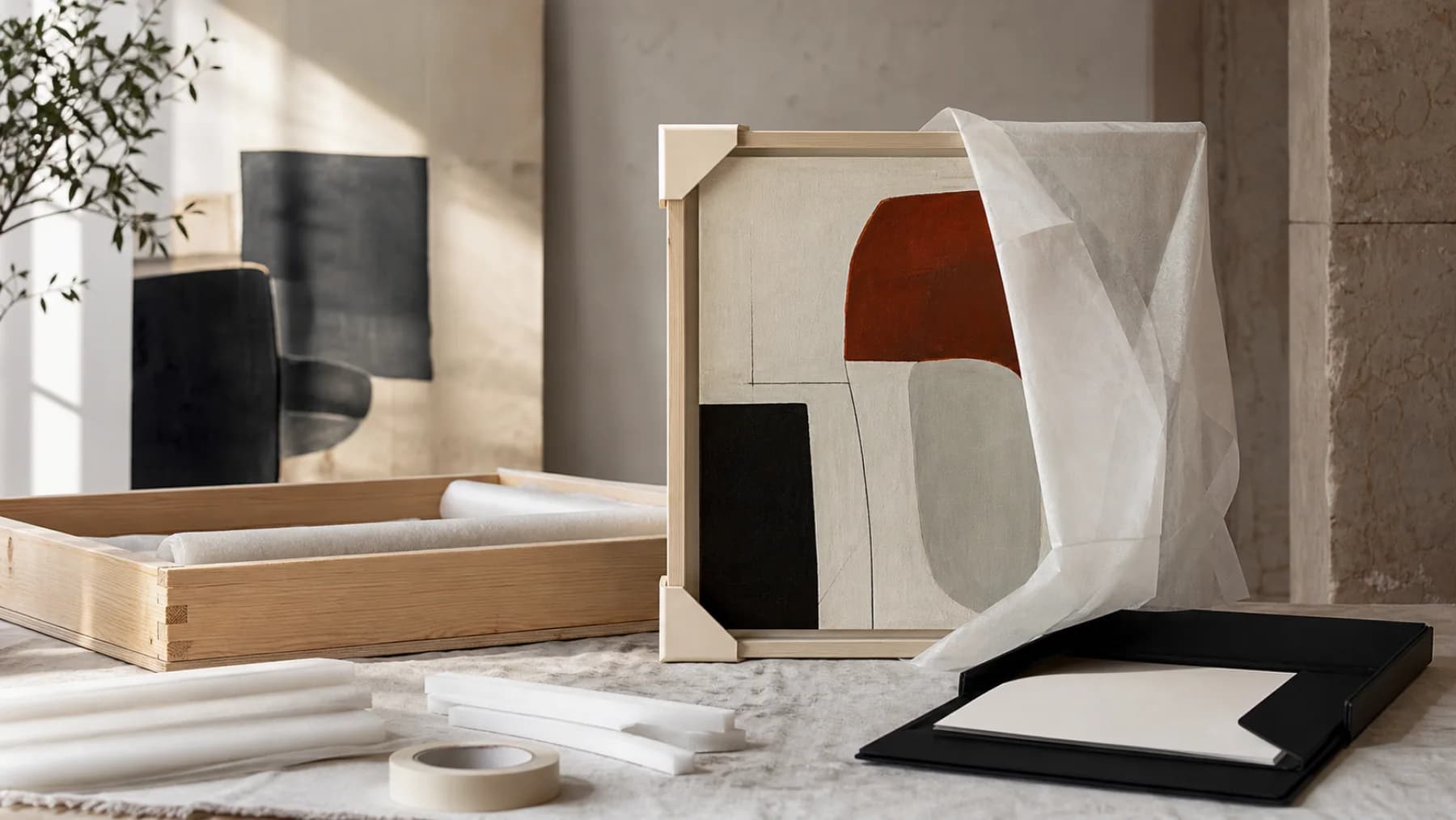
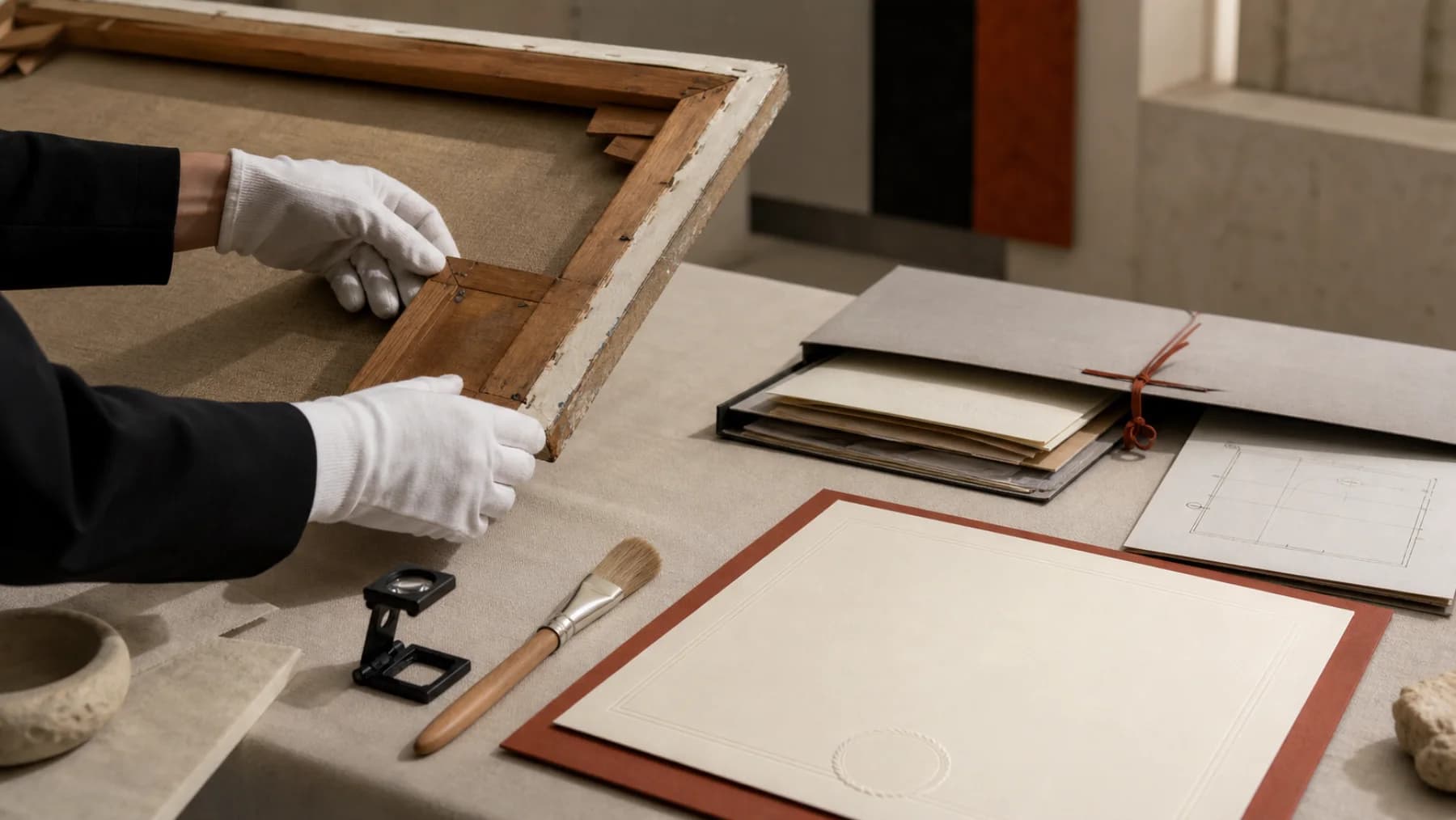
How to Store Finished Artwork: A Long-Term Storage Guide
What this helps you do
Protect finished work and find the right piece when it is needed.
Most artists end up with more finished work than they expect. The way you store it determines whether it arrives at its eventual home in the same condition you finished it. It also determines whether you can actually find a specific piece when a gallery, collector, or estate executor asks for it. Here is a practical approach to storage in a normal studio.
The four threats
Every long-term storage decision is a response to one of four things: light, humidity, temperature, and contact damage. If you are protecting against those four, you are doing most of the work.
- Light. Both UV and visible light cause fading and yellowing over years. Even indirect daylight is damaging if a piece is permanently turned toward a window.
- Humidity. Wood panels swell and crack in damp conditions. Paper buckles, foxes, and grows mould. Aim for 40 to 60 percent relative humidity, and keep it stable rather than perfect.
- Temperature. Extremes accelerate every other problem. Avoid lofts, garages, and outbuildings without insulation. A normal room temperature range is fine.
- Contact damage. Scuffs, punctures, and pressure marks from poor stacking. The most common kind of damage in a working studio.
Storing paintings on canvas and panel
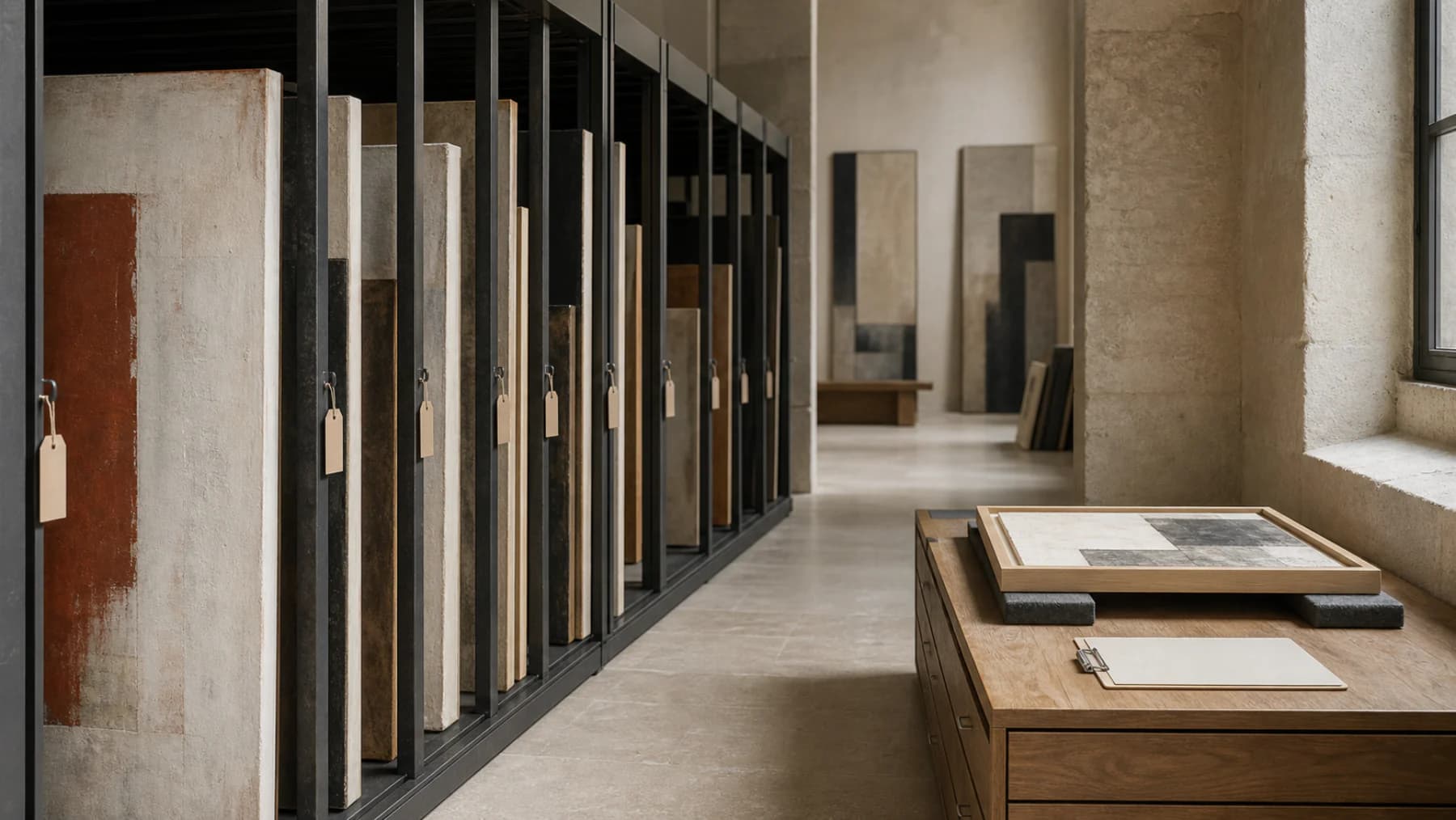
Stretched canvases should be stored vertically, never flat, unless they are in a purpose-built crate. Stacked horizontally, their own weight will dent the surface over time. A simple painting rack with vertical dividers is the single best storage investment a painter can make.
- Slide each painting in face to face or back to back, never face to back. This stops a stretcher bar pressing into the painted surface of the next piece.
- Use foam corners or simple cardboard spacers between paintings to stop edges rubbing.
- Keep at least two inches off the floor. Studios flood, leaks happen, and a wood-block riser is cheap.
- Cover larger or more valuable paintings with breathable fabric (a clean cotton sheet works fine). Avoid plastic sheeting in direct contact with the surface; it can trap moisture and stick to varnish in warm weather.
For long-term storage of unstretched canvases, roll the canvas paint-side out around a wide-diameter cardboard tube (six inches minimum) lined with acid-free tissue. Rolling paint-side in causes micro-cracking; paint-side out compresses the canvas slightly and puts the paint film in tension rather than compression.
Storing works on paper
Paper is the most fragile thing most artists make and the easiest to store badly. The standard solution is a flat file (often called a plan chest or map cabinet) with shallow drawers. If a full flat file is not in budget, archival portfolio boxes give you most of the same protection.
Inside the drawer or box:
- Interleave each work with acid-free, lignin-free tissue or glassine. Cheap newsprint will yellow and migrate acid into the paper.
- Store flat, not folded or rolled. Pastels, charcoals, and graphite drawings should be sprayed lightly with workable fixative or interleaved with smooth glassine to prevent transfer.
- Avoid rubber bands, paper clips, and adhesive tape on the work itself. These all leave permanent marks.
- Keep humidity stable. Paper expands and contracts with moisture, and repeated cycling causes long-term damage.
Storing photographs and prints
Editioned prints and photographs need an even cleaner environment than drawings. They are often the part of an artist's inventory most exposed to fading.
- Store in archival sleeves (polypropylene or polyester such as Mylar). Avoid PVC, which off-gasses and damages images over time.
- Keep prints flat in archival boxes or shallow drawers, with interleaving sheets between each piece.
- Store away from light, in a stable temperature, and well clear of any source of moisture or off-gassing materials (wood, fresh paint, cleaning chemicals).
- Keep edition records separate from the prints themselves, so a disaster in storage does not destroy both the work and the documentation.
Climate and the realistic studio
Few artists have museum-grade climate control. The good news is that you do not need it. What matters most is stability, not perfection. A room that stays roughly between 18 and 24 degrees Celsius (65 to 75 Fahrenheit) and 40 to 60 percent humidity will serve almost any work.
A few cheap tools that are worth having:
- A digital hygrometer with maximum and minimum tracking, so you can see how much your studio actually swings.
- A small dehumidifier if your storage space runs damp, or a humidifier if it runs dry in winter.
- A clip-on light meter or a simple lux app, to check whether a corner you thought was dim is actually receiving substantial indirect daylight.
Find what you stored
Storage is half the problem. The other half is being able to find a specific piece three years later when a collector calls. The solution is a consistent labelling and inventory system from the first painting onward.
- Give every work an inventory code (most artists use a combination of year and number, such as 2025-014).
- Write the code on the back of the work, on the storage sleeve or label, and in your records.
- Note the storage location alongside every record (rack 2 slot 7, flat file drawer C, archive box 2024-A).
- Update the location whenever a piece moves: to a gallery, to a client, into a frame, into a shipper's crate.
A well-organised storage room with no inventory is a haystack. A modest storage room with up-to-date records is a working archive. The records are what turn the studio into something that can outlast you.
A short pre-storage checklist
Before any finished work goes into long-term storage, run through:
- The work is signed and dated.
- The verso has full inscription.
- You have a clean, well-lit photograph of the front and back.
- The piece has an inventory code recorded somewhere outside the studio.
- It is properly packed or interleaved for the storage method.
- Its location is logged.
Five minutes of attention now saves hours of searching later, and can be the difference between a piece that survives and one that does not.
Know exactly where every painting lives
Artwork Codex tracks location alongside every artwork record, so when a piece moves to a storage rack, gallery, or buyer, the trail stays current.
Paid checkout requires a card. Cancel anytime. The Free plan remains available without a card.
Free plan available. Storage that is searchable is storage that works.