How to Number Art Editions: A Guide for Printmakers and Photographers
What this helps you do
Define the edition once and identify every physical copy.
Edition numbering is a small detail with big consequences. It determines rarity, pricing, collector trust, and your reputation for professionalism. Getting it right, and keeping the records to prove it, is straightforward once you understand the conventions.
What the numbers mean
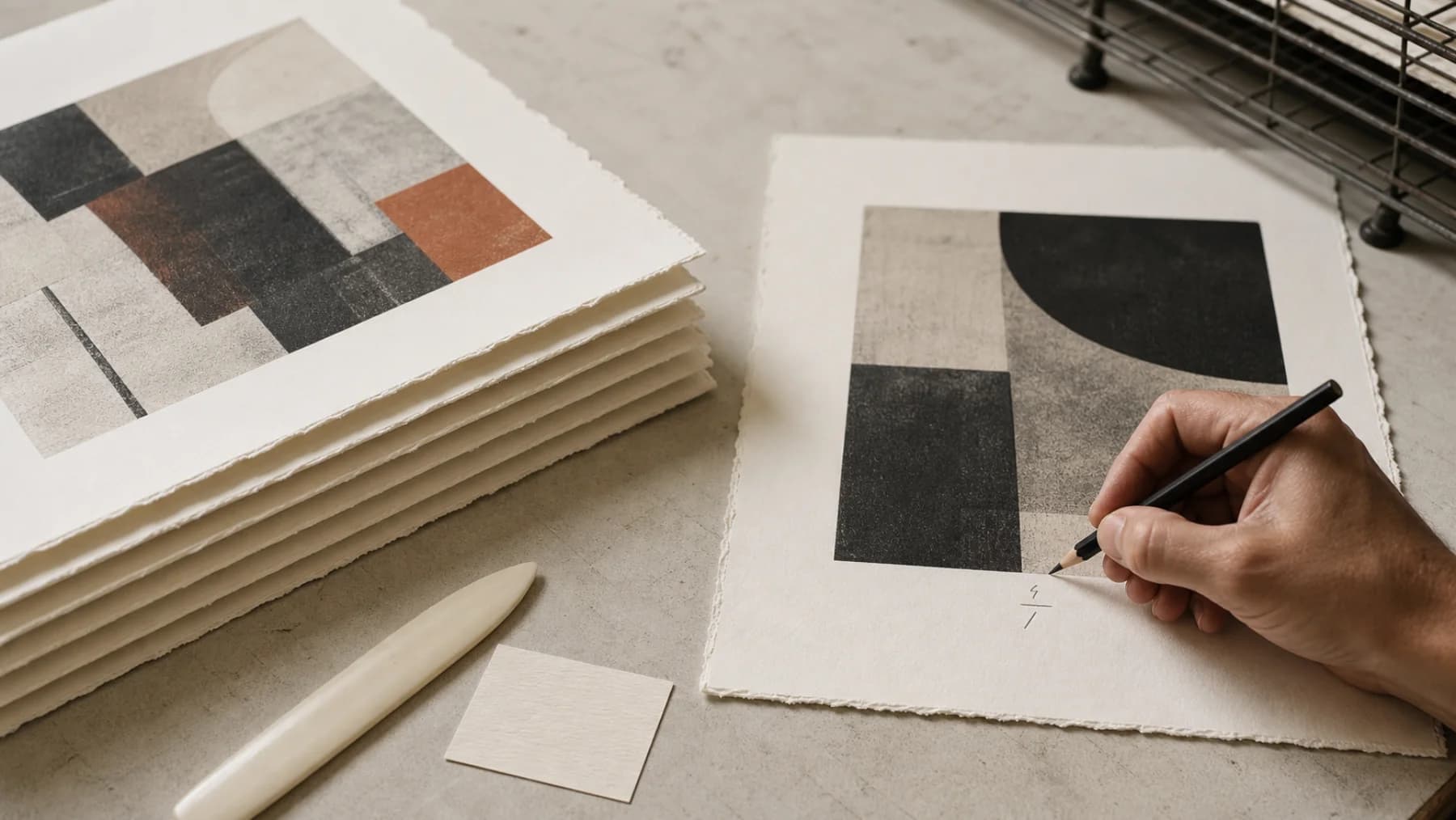
Edition numbers are written as a fraction: 4/25. The number on top is this specific copy. The number below is the total edition size. So "4/25" means this is the fourth copy in an edition of twenty-five.
Conventionally, numbering does not indicate the order the copies were printed. A 4/25 is not the fourth print pulled. It simply identifies a copy within the edition. This is why declaring the edition size up front and never growing it is the core rule of edition integrity.
The different kinds of copies in an edition
- Numbered copies: the main edition (e.g. 1/25 through 25/25).
- Artist's Proofs (A.P. or E.A. in French): typically 10%–20% of the edition, for the artist's own use or sale. Numbered A.P. 1/5, A.P. 2/5, etc.
- Printer's Proofs (P.P.): given to the printer, usually 1–2 copies.
- Hors Commerce (H.C.): "not for commerce." Reserved for special purposes such as exhibitions or gifts.
- Bon à Tirer (B.A.T.): "good to pull." The approval proof the printer uses as the reference for the edition. One copy only.
All of these copies count towards the effective total of the work in circulation. A responsible artist discloses the full picture, not just the numbered main edition.
Choosing an edition size
Edition size affects price, pace of sale, and perceived rarity. Common conventions by medium:
- Fine art photography: often 3–25
- Etching, lithography: 10–75
- Screenprinting and risograph: 25–100+
- Bronze sculpture: traditionally 8 + A.P.
- Digital prints: highly variable, but smaller editions command higher prices
A smaller edition means higher individual prices but slower total revenue. A larger edition moves more units at a lower price. The decision is strategic. What is not strategic is changing the edition size after the fact. That is what destroys trust.
Where to write the numbers
Convention for prints and photographs:
- Edition number, bottom-left, in pencil
- Title (optional), bottom-center, in pencil
- Signature and year, bottom-right, in pencil
Pencil is the standard for prints because it's a signal of a hand- signed, hand-numbered copy rather than a machine-printed caption. For photography, the edition number is sometimes printed on the reverse or on the certificate rather than on the print itself. Either is acceptable; what matters is consistency across the edition.
The records collectors expect
For every edition, you should be able to produce:
- Total edition size, including A.P., P.P., and H.C. copies
- A per-copy log: which numbers have sold, to whom, and when
- Status of each copy: available, held, sold, destroyed
- A Certificate of Authenticity with the specific copy number
- Printing date, printer (if not you), paper, and any technical notes
This is the point at which a spreadsheet gets unwieldy. Dedicated art inventory software that tracks each edition copy as its own record makes this straightforward.
What destroys an edition
- Printing more copies than you declared. This is fraud in commercial terms.
- Producing "second editions" of the same image at a different size or format without disclosing that the original edition exists.
- Losing track of which numbered copies have sold.
- Issuing Certificates of Authenticity with contradictory edition information.
- Signing and numbering copies inconsistently.
The correction for all of these is the same: one source of truth for the edition, maintained from the moment the plate, file, or mold is made.
When an edition is closed
When the final copy is sold, the edition is "sold out." Responsible artists cancel the plate, destroy the file master, or otherwise mark the edition formally closed, and say so publicly.
This matters more than it sounds. It's what lets the collectors who bought your work trust that their copy retains value. Skipping that step is how second-market prices collapse.
Track every edition copy in one place
Artwork Codex lets you record the full edition size, artist's proofs, and the status of each individual copy, so you always know what's sold, held back, or still available.
Paid checkout requires a card. Cancel anytime. The Free plan remains available without a card.
Free plan available. Edition-copy tracking is available on every plan.