How to Track Artwork Locations Without Losing Work
What this helps you do
Know where every artwork is and where it has been.
The moment artwork leaves the wall beside your easel, memory starts to fail. A painting goes to a framer, three prints go to a gallery, two older works sit in storage, and a collector asks what is still available. Location tracking is not glamorous, but it is one of the habits that separates a working studio from a room full of objects.
At a glance
Key takeaways
- Record the physical location, move date, contact, purpose, and expected return date whenever a work leaves the studio.
- Keep location separate from availability, ownership, and sale status so each answer stays reliable.
- Use the same labelled rack, shelf, drawer, and crate names in the room and in the artwork record.
Define what location means
A useful location field should answer a real question: where is the physical work right now? That might be studio rack B, flat file drawer 3, East Wall of the open studio, Modern Line Framing, a gallery, a collector, or a storage unit.
Do not mix current location with ownership, availability, or exhibition history. Those are related, but they are not the same thing. A work can be owned by a collector and temporarily at a conservator. A work can be available for sale and still on consignment.
Use location names you will understand later
Vague locations become useless quickly. Studio is better than nothing, but studio rack A, slot 12 is much better. Storage is weak. Big Yellow unit 410, shelf 2 is useful.
Create a short list of location names and reuse them. If you type a new version every time, searching becomes unreliable. A controlled vocabulary is not bureaucracy. It is a kindness to your future self.
- Studio rack A
- Flat file drawer C
- Framer: Modern Line
- Consigned: Finch Gallery
- Collector: private collection
- Storage unit: shelf 4
Record every outward move
The most important habit is to update the record before or during the move, not after. Once a work leaves the studio, the details scatter into emails, shipping labels, and memory.
For each outward move, record the destination, date, contact person, reason for the move, expected return date if there is one, and any paperwork connected to it. That record protects you if the work is delayed, damaged, sold, or forgotten.
Separate available from present
A work can be physically in the studio but unavailable because it is promised to a show. Another can be at a gallery and still available. Do not use the location field to carry all of that meaning.
Keep availability, status, sale state, and location as separate fields. This makes it easier to answer practical questions: what is available for a collector, what is at a gallery, what is out on loan, and what can ship this week.
Label storage to match the record
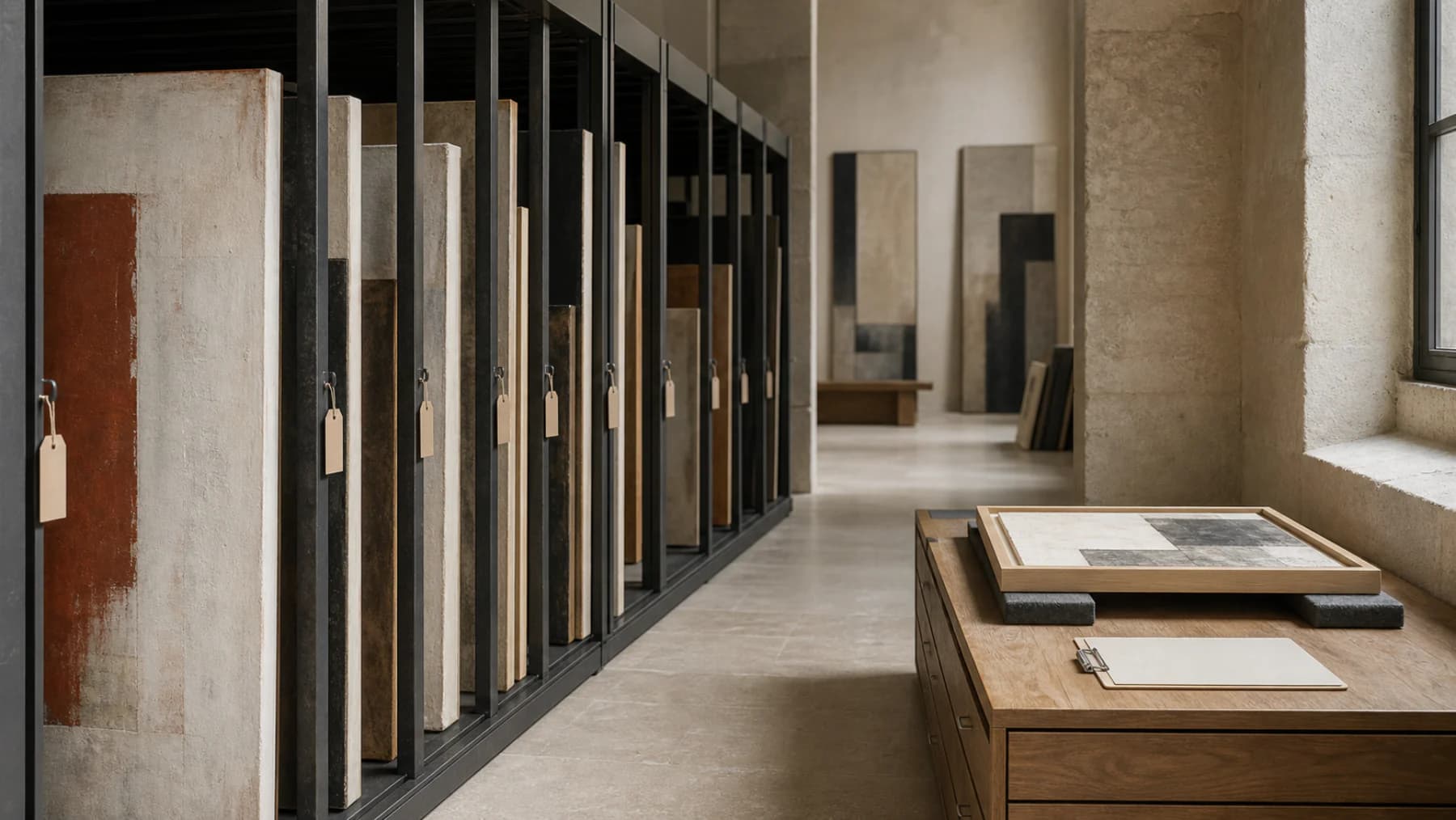
Location tracking works best when physical storage and digital records mirror each other. If the record says rack B, slot 7, the rack should actually be labelled B and the slot should be findable.
You do not need museum storage. You need a simple scheme that you can maintain. Label racks, flat file drawers, archive boxes, shelves, crates, and portfolios. Then use the same names in your records.
Audit locations twice a year
Even careful studios drift. Works move quickly before openings, sales happen during busy weeks, and storage decisions get made in a hurry. Twice a year, walk the room with your inventory and check that every current location still matches reality.
A location audit is faster than rebuilding the archive from memory. It also catches problems early: missing works, undocumented consignments, unsold works that should have been returned, and pieces that still need better photography.
Worked example
A move record that answers the next question
For a painting sent to a framer, record: location, Modern Line Framing; moved, 14 May; contact, studio manager; purpose, floating frame; expected return, 28 May. When a collector asks about it, you can answer without searching through messages.
Track every artwork move in one place
Artwork Codex stores current location, availability, consignment status, sales, contacts, and images on each artwork record so you can find the work when someone asks.
Paid checkout requires a card. Cancel anytime. The Free plan remains available without a card.
Free plan available. Location history becomes more valuable every year.